

Rediscovering Plus-Minus-Next for Journaling
A three-step review process that changed how I periodically reflect on the past, present, and future.


One of the most useful practices I took up early in 2025 was the use of PMN, or Plus-Minus-Next, for daily and weekly reviews. Journal entries and reflection was always a challenge for me, because I never really knew where to start. I would start writing about something in my day, and think, “Where is this actually going?”, and then drop the activity altogether. Over the past decade, a graveyard of half-finished journal entries across different apps and physical notebooks has grown.
But early this year, I ran into the book “Tiny Experiments” by Anne- Laure Le Cunff, a productivity/self-help book focused on minimizing the pressures and expectations of creation by reframing creative work and reflection as a “scientific process”: To make a hypothesis about something I might be interested in, test the hypothesis by doing it for a limited amount of time, and reflecting on the experience as a point of data rather than a review of self.
Turning what seemed large, looming projects into bite-sized, curiosity-driven chunks, I was able to finally conceive journaling as a way to consider the data of my experiences without a full existential review. But what made journaling even more powerful for me was the use of Plus-Minus-Next, which is a quick three-step system to writing what went well, what didn’t, and what I could do about it to make it better.
Seems a bit obvious and simple, but for an over-thinker like myself, the obvious and simple stuff of life just doesn’t come naturally to me. You kind of realize that all these self-help books are very large and wordy paths that help you just simply come back to yourself.
I made a 90-day experiment testing the hypothesis that using Obsidian, and its Daily Note feature, which automatically creates a pre-formatted note for you to fill in each day, would be a great way to use PMN, as I could end the day opening the app and entering in the positives, negatives, and the ways to improve. Very simple and highly actionable.
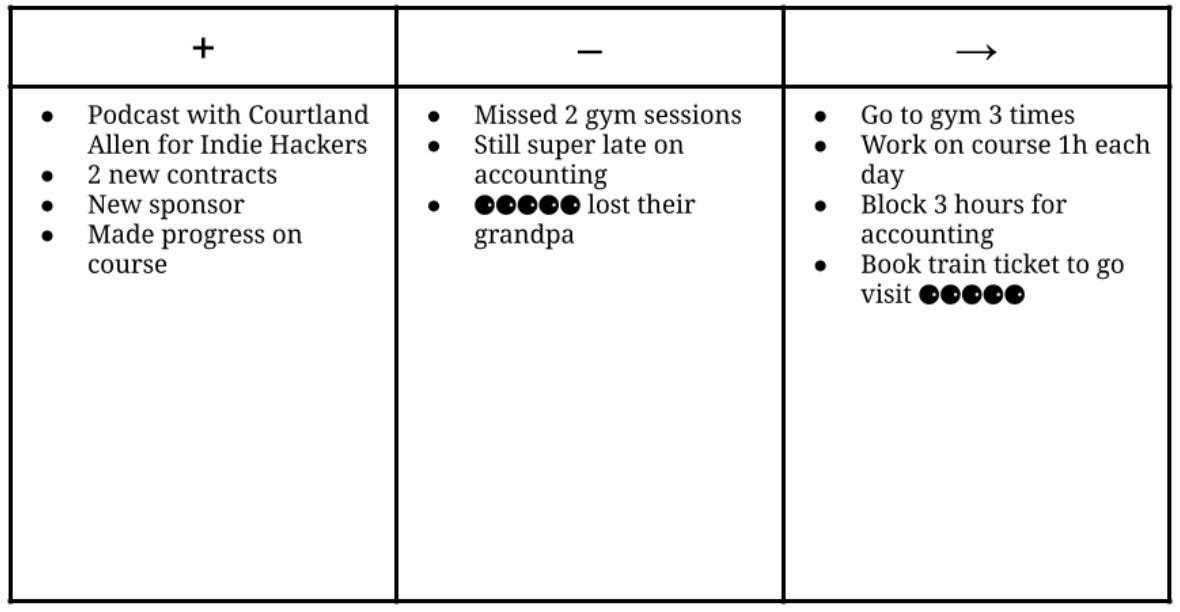
From May through August of this year, I semi-successfully entered answers to the PMN system, and it became a good habit in my life. So good, that there are times when I had to verify when I did a specific thing on a specific day, that I could refer back to these daily notes and find it, which is something I’ve only been able to do using the Photos app (this is also a very good method of daily remembrance, so long as I’m actively taking pictures).
I’ve always had aspirations of a daily written journal, and for years have tried using the Bullet Journal system, but after a week or two, I would forget about a day, feel behind, feel bad, and then drop it. And worse off, I couldn’t even easily refer back to the data because it was on paper.
The Obsidian-based Plus-Minus-Next system of journaling and reflection has so far been the best system I’ve ever had in consistent note-taking.
But, after the 90-day experiment, I for some reason completely dropped it, which is a complete shame. The most useful thing, just collecting dust for little more reason than my erratic-ness with consistency for anything. I’m a good burst person, and the agreement I had for myself to do it for 90 days worked with that burst mentality. Then, it was over, and the burst was gone.
Now it’s December, and I’ve barely opened up Obsidian. What a shame.
This week, I attended the “Tiny Experiments” author’s workshop about how she does her annual review. It re-introduced the Plus-Minus-Next process again, which made the draft version of the review super easy. I had thought, “Boy, an annual review? That’s going to take hours to get off the ground.” It was done in minutes, using Le Cunff’s process of spending only 1 minute on each Plus, Minus, and Next for the 9 categories she laid out:
Health/Fitness
Work/Business
Personal Life/Family
Friends/Community
Learning/Knowledge
Travel/Culture
Hobbies/Creativity
Emotions/Spirituality
Money/Finance
3 minutes for each category. The whole process flew, and now I have a working skeleton on what I enjoyed for each of these areas of life, what could have gone better, and actionable items for future improvements. Again, so simple, so obvious, so easy. It broke through all my mental barriers to do what I thought was “big and complex”.
Even more helpfully, the quick, intuitive thinking I used revealed some patterns in the Next category. There were a lot of “more time to do X” or “less time to do X” improvements, which meant that the core of what I needed to focus on was balancing my time spent on different activities, whether it’s my educational interests, hobbies, fitness, or work.
Once I collect all this information together, I’ll be able to see what I truly value in the time that I spend on things, and enter each day with a bit more structure on how I spend that time. Energy/time use has been at the background of the past few months, but without me really putting a finger on that as the actual issue. Up until now, it just felt like a vague pressure, that something is missing and I didn’t know what.
Writing the data down and reviewing it helped me pinpoint exactly what needs to be worked on. The step-by-step process to fix it all? I’m not entirely sure yet, but it’s a great start compared to where I was just before the workshop.
If you’re looking for a quick, easy way to journal with practical use in mind, try Plus-Minus-Next, and see how it can be incorporated into different areas of your life. It’s one of the most useful reflection tools I’ve used in my 14 years of search. If only I found it when I got out of high school!